No Walls, No Wi-Fi, No Problem: Inside the Streaming Playbook of America's Van-Dwellers
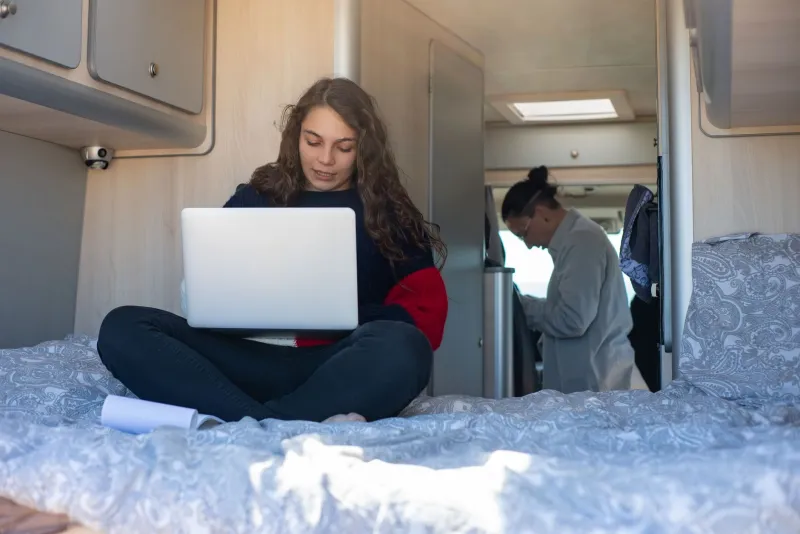
There's a running joke in the van-living community: you didn't really choose the nomad life until you've driven 40 minutes to a Walmart parking lot just to download an episode of a show you're only half-watching anyway.
But spend any real time around America's mobile-living crowd — the full-time RVers, the school-bus converters, the Honda Odyssey campers parked outside national parks — and you'll notice something surprising. These folks might be the most sophisticated free-streaming users in the country. Not because they're cheap (okay, partly because they're cheap), but because life on the road forces you to get intentional about entertainment in a way that suburban cable subscribers never have to be.
When Your Living Room Has a Fuel Gauge
For the average household, streaming is a background decision. You plop down, you press play, you forget about it. For someone whose house gets 25 miles to the gallon and whose internet is whatever tower happens to be within range, every episode carries a small calculation: data used, battery drained, signal strength, and whether tonight's campsite has anything resembling coverage.
That math changes everything. A couple we'll call Dana and Rick — retired, full-timing in a 28-foot travel trailer, currently somewhere outside Moab — put it plainly: "At home, we never thought about TV. Out here, we plan our viewing like we plan our driving days."
Their system? A mix of free, ad-supported streaming services for when they've got solid signal, a healthy library of offline downloads for when they don't, and an over-the-air antenna that pulls in local channels for nothing. Total monthly entertainment bill: zero dollars. Compare that to the satellite TV packages that used to be standard equipment in the RV world, and it's easy to see why the old ways are dying.
The Free Streaming Stack, Nomad Edition
The free streaming landscape — those ad-supported platforms offering thousands of movies and full seasons at no cost — is tailor-made for the road. There's no login juggling, no subscription to cancel when you're boondocking in the desert for a month, and no bill showing up at a mail-forwarding address three states away.
The typical nomad stack looks something like this:
- One or two free ad-supported platforms for the main rotation. Full seasons of comfort shows, a deep movie catalog, zero commitment.
- A live TV option for news, sports, and the comforting illusion of channel surfing. Free live TV services stream local and national channels over the internet, no cable card required.
- Over-the-air antenna as the offline backup. A $30 antenna on the roof of an RV can pull in dozens of local channels — and unlike satellite, it works during storms and never loses signal because someone's tree is in the way.
The genius of the setup is redundancy. If the cellular signal dies, the antenna picks up slack. If the antenna gets nothing in a remote canyon, the downloaded queue takes over. There is always something to watch, and none of it costs a dime.
The Offline Download Ritual
Ask any seasoned van-dweller about their routine and you'll hear about "town days" — the trips into civilization for laundry, groceries, propane, and, crucially, Wi-Fi.
Library parking lots are the unsung heroes of the mobile-living world. So are Starbucks, Cracker Barrel, and the humble McDonald's, where a large fries buys you an hour of bandwidth. The ritual is always the same: connect, open your streaming apps, download everything your device will hold, and get out before you overstay your welcome.
A single tablet can hold a shocking amount of entertainment. A season of a half-hour comedy, a couple of movies, some documentaries for rainy days — all of it downloaded free, all of it playable at 2 a.m. in a national forest with zero bars. The ads on free platforms even tend to load once and stay cached, so the offline experience feels nearly seamless.
Data Caps: The Great Equalizer
Here's where nomads have a genuine advantage over the rest of us: they learned data discipline out of necessity, and it turns out that discipline pairs perfectly with free streaming.
When you're rationing gigabytes, ad-supported free platforms start looking a lot smarter than a premium subscription you can't reliably use. Why burn precious hotspot data on a paid service's 4K stream when a standard-definition free stream does the job just fine on a 24-inch screen? The picture quality debate that rages on Reddit evaporates when your TV is the size of a laptop and your bandwidth is measured in bars of signal.
The community has developed its own folk wisdom around this: download overnight when tower congestion drops, keep video quality settings low on cellular and high on campground Wi-Fi, and never — never — let a software update run on mobile data.
Cord-Cutting Hits Different at 60 MPH
There's a certain poetry to it. The RV generation was sold satellite dishes and hundred-dollar cable packages for decades — entertainment priced and packaged for people who lived in one place. The mobile-living crowd looked at that model, laughed, and rebuilt entertainment from scratch: free platforms for the bulk, downloads for the gaps, an antenna for the locals.
And honestly? Their playbook works just as well with a foundation under it. If you've ever looked at your streaming subscriptions and wondered what you're actually getting for the money, spend an evening the way a van-lifer would — a free platform, a downloaded backup, a $30 antenna — and see if you miss the bill.
The road doesn't have reliable Wi-Fi. Turns out it doesn't need it.